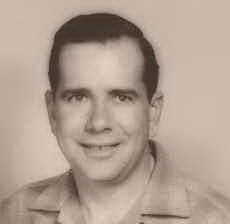
This article originally appeared as a three part series in the Ladysmith News, Ladysmith Wisconsin, from February 25, 1949 to March 11, 1949 and is transcrbed word-for-word.
Clarence Clough was discharged from the U.S. Marine Corp in February 1946. During his life, he never claimed the medals awarded to him. After his death in 1985, his family made the request and received the following medals:
Silver Star, Purple Heart, Presidential Unit Citation with Bronze Star, Distinguished Unit Badge with two Oak Leaf Clusters, Asiatic Pacific Theater Ribbon with Bronze Star, American Defense Ribbon with Bronze Star, China Service Medal, World War II Victory Ribbon, Good Conduct Ribbon.
Former Marine Tells of Prison Camp Horrors to Support Claim Against Japs
A Rusk county ex-marine who spent nearly three and one-half years as a prisoner of the Japanese is making his way as a mink rancher and attempting to forget an experience that thousands of other American soldiers failed to survive.
He is Clarence Clough, 30 year old Appolonia man, who spent from May 6, 1942, to September 5, 1945, in the hands of the Japs at various concentration camps and work stations in the Philippine Islands and Japan.
During his incarceration, Clough contracted malaria, dengue fever, dysentery and beri-beri. He is rated with the Veteran's Administration as being 30 percent disabled. Clough says: “I don’t believe there is a single man who spent time in a Japanese prison camp without emerging in considerably poorer condition than when he was captured, and most of them will never be nearly as fit again as they were before the war.”
Clarence Clough is one of 20-odd Rusk county men who will file claims against foreign governments for compensation due them as a result of mistreatment as prisoners of war.
Married last fall, Clough and his attractive young wife are living in a neat cement block building on the north side of U.S. highway 8 two miles west of Bruce. Clough plans to use the present building for a garage and build a larger home later. He has 600 mink, which keep him busy, but his mind is still full of the horrors of his days as a prisoner, when his weight went down from 186 to 104 pounds and his fellow Americans died like flies around him in the filth of concentration camps or at the brutal work stations.
Recently, the former marine wrote an account of his experience as a prisoner. The story has been turned over to County Service Officer Ray Smith and will be filed with the Veterans’ Administration in connection with Clough’s claim against the government of Japan. Some of Clough’s information has been used as evidence in war crime trials. The News has received permission to use the story, told in Clough’s own words, which will follow in this and succeeding issues.
Clough Tells His Story
Many things stand out as landmarks during the 3 ½ years I spent as a prisoner of the Japs. The story goes back to November 5, 1940, when I joined the United States marines. I served with the Fourth Marines, Shanghai, China, from Jan. 1 1941, to Dec. 2, 1941.
In the days preceding the Jap attack on Pearl Harbor, my outfit was moved to Bataan, and later to Corregidor, where the last stand was made against superior forces of the Japanese. I served as a machine gunner.
On Bataan before the capture, many of us had a prelude of what was to come later - near starvation. Before we surrendered our fare got down to a bacon sandwich a day, and on days of heavy bombardment, there were no sandwiches. Before my capture by the Japs, I had the experience of eating bats, monkeys and even a cat.
A Filipino buddy who was clever in the water would spear small octopi. It was he who brought in the bats. He cooked them with tomatoes he had found in a blown-up food dump. They weren’t bad. Neither was the monkey and cat - to starving men.
On May 6, 1942, I was taken captive by the Japanese and was held by them on Corregidor until June 9, 1942. During that period I worked with other prisoners repairing the airfield on that island.
When the airfield was finished (and not before) we were finally given the gruesome task of cleaning up the debris and burying the dead. Many dead Americans had lain for as long as two weeks in the hot tropical sun before there blackened bodies were crammed into holes and coved up. During this time, our food consisted mainly of what scraps we could salvage from the debris.
On or about June 9, 1942, the rainey season began and our camp area (92cd garage, Corregidor) was flooded. The 6 or 7,000 men crammed into about an acre of space spent the night in water from 12 to18 inches deep. Many of the sick or badly fatigued men lay with their bodies coved entirely with water, their heads propped upon whatever was available.
The following morning we were herded into holds on a Japanese army transport and moved to Manila.
The ship anchored just off shore and we were forced to disembark in waist-deep water. We waded ashore and were marched through the streets of Manila to Bilibid prison. Here we were issued one rice ball each and allowed to lay on the ground until morning.
At dawn we were marched to the railroad and were loaded in narrow gauge box cars, 100 men to each car. In this fashion we were transported from Manila to Cabanatuan. The doors of the cars were closed and the heat was almost unbearable in our cramped positions. At Cabanatuan we unloaded and were forced to march overland a distance of about 25 miles to the concentration camp. Some of the men who were unable to make the long hike without water passed out and were bayoneted where they fell.
(In next week’s installment, Clough tells how he was exposed to the dread disease of leprosy at the Culion Leper Colony and of forced labor carving an airfield out of the jungle at Palawan. --Editor)
Clough Tells How Japs Burned Americans Alive on PalawanClarence Clough, 30-year-old Rusk county ex-marine, has written a summary of his adventures as a prisoner of war of the Japanese during world war II. The story, sworn to before a notary public, is being filed with the Veterans’ Administration to support Clough’s claim for compensation with the Japanese government.
The first installment of Clough’s own story appeared in the Ladysmith News last week. It told of his capture on Corregidor on May 6, 1942, and the ill-famed “death march” of weakened Americans 25 miles to a concentration camp in the Philippines.
This week’s installment goes on to tell of conditions at the camp.
Japs Hold Inspection
Upon our arrival at the concentration camp we were forced to stand for hours in the hot sun while the Japs inspected what few possessions we had. When this was completed we were assigned to our respective barracks. These barracks were long nepa shacks with a shelf made of bamboo slats for us to sleep on. The floor was dirt and the roof far from waterproof. Bedbugs, lice and fleas were everywhere, and as our latrines were straddle trenches scattered about the camp, dysentery spread like wildfire. Our work here was to build up the camp. Our diet consisted of rice and usually thin watery soup made from potato vines or most any sort of grass. I remained in this camp until July 20, 1942. At that time I was again loaded into a box-car and returned to Manila with 300 others.
At Manila we were taken to the dock, where we loaded a transport with supplies of various descriptions. When we had completed this we were crammed once more into hold of the ship and set sail for - we did not know where.
Several days later we anchored at the Culion leper colony and unloaded part of our cargo. Many of us were sent ashore, where naturally we were exposed to the dreaded disease - leprosy. The following day we again set sail and arrived a few days later at Puerto Princessa, Palawan. This we discovered was to be our new home, and although we did not know it at the time, for half of the men it was to be their last home.
On Palawan our living quarters was the old Philippine constabulary building, a rambling “U” shaped building with wood floors and shingled roof. One could step through the floor almost anywhere and the roof was far from tight. Located about nine degrees north latitude, the climate was extremely hot, except for about three months during the rainy season.
Our job on Palawan was to carve out of the dense jungle an airfield. The little clothing which we had worn since the time of our capture was by this time in tatters. Most of us wore only a “G” string and worked barefooted. This was a little rugged in the jungle, especially since the area in which we worked was covered with coral. For a long time our only tools were a sort of odd-shaped hoe, which we used to cut down trees, dig out stumps, level ground and pick coral, and an ordinary hand sickle for cutting the grass and vines.
We worked 12 hours a day. Our food was about the same as that at Cabanatuan - rice and green soup. On a few rare occasions we were given a fish head, or had bones from horses to flavor the soup. We were fed three times a day, about a teacup of rice each time. Fruit from the trees cut down was left to rot on the ground. Any that we ate was eaten at the risk of our lives, or at least a broken arm. We were divided into groups of ten men each. If one man escaped or attempted to escape the other nine men in his group and his unit commander were to be immediately shot. This system was put into effect in nearly all the camps and was carried out whenever the occasion arose. However, escape attempts were virtually eliminated. What man would attempt escape and leave10 of his buddies to be shot? Hardly a day went by without some man being beaten, kicked or clubbed, often without the slightest provocation. Nearly all of us contracted malaria, but were forced to work, sometimes with temperatures as high as 104 degrees.
(Concluded next week)
Former Jap Prisoner’s Health Impaired from Long Internment
Clarence Clough, of Appolonia, marine veteran of world war II, has written a story of his experiences as a prisoner of war of the Japanese to support his claim for compensation against the government of that country. This is the third and final installment of Clough’s own story. At the end of last week’s chapter, Clough was working with other prisoners on a Jap airfield at Palawan.
On Decenber20, 1943, as the project was nearing completion, I together with half of the others , was again loaded on a ship in the same fashion as before and was taken back to Cabanatuan. I later learned that when the American offensive started in the Philippines, the remaining 150 men were forced into air-raid shelters, gasoline was poured on them and they were burned alive. This story was vividly told in August,1945 issue of Liberty Magazine, by two of my best friends, Rufus W. Smith, of Hugh Springs, Texas, now located at Dallas, Texas, and Glenn McDole of Des Moines, Iowa, now located at Mt. Ayr, Iowa. They were two of the nine who escaped from the Palawan massacre.
I spent the next three months at Cabanatuan. Here for the first time, I received mail from home and a small amount of food from the American Red Cross. Things hadn’t changed much at Cabanatuan except for the fact that the men were working on what they called the ”Farm.” From this farm they were allowed to use part of the potatoes, greens and squash in the American “galleys.”
About the first of March, 1944, I was again put through the now familiar methods of transportation, and taken to Japan. In Japan we set up a camp on a mountain top and were put to work in a copper mine at Astashi. Every mourning at six o’clock we would worm our way down the mountain side, crawl down a ladder - with many of the rungs rotted away - to the 80-degree meter level a half mile underground (some of the men worked even further.) Most of the guards in the mine treated us fairly well, but the food was even poorer than in the Philippines and the camp guards were of the same caliber as our previous ones - bullies. The rice was replaced with barley or maize, which was far inferior to rice as a sole diet. We grew weaker with each day. Nearly always we would have to carry drill bits, dynamite, shoring material, etc., down into the mine with us, and when we finished work at 6 p.m. we would be given an armload of wood or a log to be carried back to the camp. As we were no longer in the tropics we were issued a light work uniform and one blanket per man. I stayed in this camp until it was abandoned about the 15th of August, 1944.
I was then transferred to Ashio, Japan, where I did the same type of work under identical conditions. As winter came on we formed little “cliques” in the camp. About five of us would get together and spread two blankets on the floor, the other three blankets we spread over us, and in this manner succeeded in getting a little sleep, even though it was below zero in our barracks. We were issued overcoats to wear to work, and they, of course, went on top of the pile at night.
We worked in two shifts. From 6 a.m. to 6 p.m. was the day shift and from 6 p.m. to 6 a.m. was the night shift, Every fifth day we would change shifts. Each day we became weaker until when we were released less than one-third of us could walk.
On Sept. 5, 1945, I was liberated by the American forces and returned to the good old U.S.A. I had reduced in weight from 186 pounds at the start of the war, to 104 pounds when I was liberated.
While a prisoner I contracted malaria, dengue fever, dysentery and beri-beri, and now have a 30% disability rating with the Veteran’s Administration as a direct result of my internment. I don’t believe there is a single man who spent time in a Japanese prison camp without emerging in considerably poorer condition than when he was captured, and most of them will never be nearly as fit again as they were before the war.
Added by Thomas Clough (not part of original article)
Radio message from General Wainwright to President Roosevelt- 6 May 1942
For the President of the United States:
It is with broken heart and head bowed in sadness, but not in shame, that I report to Your Excellency that I must go today to arrange terms for the surrender of the fortified islands of Manila Bay: Corregidor (Fort Mills), Caballo (Fort Hughes), El Fraile (Fort Drum), and Carabao (Fort Frank).
With anti-aircraft fire control equipment and many guns destroyed, we are no longer able to prevent accurate aerial bombardment. With numerous batteries of the heaviest caliber emplaced on the shores of Bataan and Cavite out ranging our remaining guns, the enemy now brings devastating cross fire to bear on us.
Most of my batteries, seacoast, anti-aircraft and field, have been put out of action by the enemy. I have ordered the others destroyed to prevent them from falling into enemy hands. In addition we are now overwhelmingly assaulted by Japanese troops on Corregidor.
There is a limit of human endurance and that limit has long since been past. Without prospect of relief I feel it is my duty to my country and to my gallant troops to end this useless effusion of blood and human sacrifice.
If you agree, Mr. President, please say to the nation that my troops and I have accomplished all that is humanly possible and that we have upheld the best traditions of the United States and its Army.
May God bless and preserve you and guide you and the nation in the effort to ultimate victory.
With profound regret and with continued pride in my gallant troops I go to meet the Japanese commander.
Good-by Mr. President.
--------------------------------------------------------------------------------From John Jacob Beck's book MacArthur and Wainwright-Sacrifice of the Philippines